
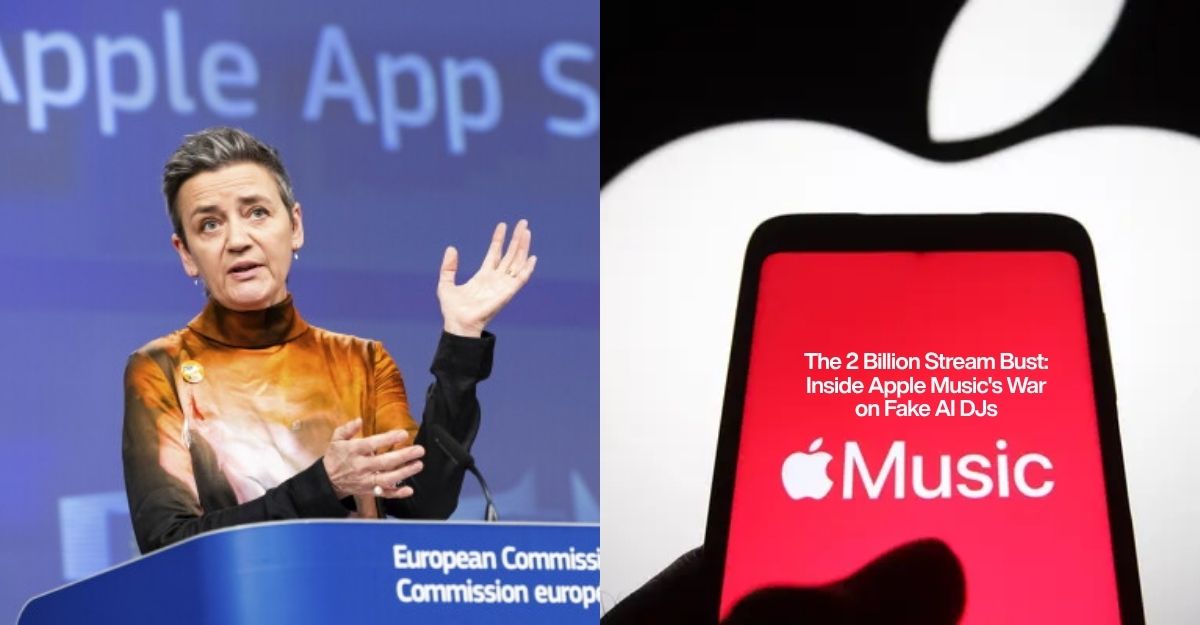
For the human artists sitting comfortably on our DJ Rich List, streaming platforms are the lifeblood of their modern wealth. But what happens when the biggest DJ on the platform isn’t actually human?
In early 2026, the music industry was rocked by an unprecedented digital heist. Apple Music officially disclosed that it had identified and demonetized an astonishing two billion fraudulent streams throughout the previous year. At the center of this crackdown was a highly sophisticated, true-crime conspiracy involving artificial intelligence, massive bot farms, and entirely fabricated DJs with names like “Calm Knuckles”.
With millions of dollars siphoned away from legitimate, hard-working artists, streaming giants are now waging a full-scale war against synthetic fraud. Here is the unbelievable true story of the biggest AI music heist of 2026, how the syndicate operated, and how Apple Music is striking back.
1. The ‘Calm Knuckles’ Syndicate
The sheer scale of this streaming manipulation scheme reads like a cyberpunk thriller. In a landmark 2026 federal case, a North Carolina man named Michael Smith pleaded guilty to orchestrating a years-long wire fraud conspiracy.
According to federal prosecutors, Smith didn’t act alone. He allegedly partnered with the CEO of an AI music company and a music promoter to manufacture the ultimate digital ghost roster. The AI company provided Smith with hundreds of thousands of completely synthetic, computer-generated audio tracks every single week.
Because the raw AI audio files featured randomized alphanumeric titles (like “n_7a2b2d74.mp3”), Smith had to create an illusion of humanity. He generated thousands of fabricated, dictionary-inspired stage names for these fake artists, dropping tracks under absurd monikers like “Calm Knuckles“ and “Zygophyceae”.
2. The Mechanics of the Bot Farm
To turn these fake DJs into millionaires, Smith had to generate billions of streams without triggering the algorithmic security alarms of platforms like Apple Music and Spotify.
The operation was a masterclass in digital evasion:
- The Family Plan Exploit: Smith purchased massive numbers of “family plans” on major streaming platforms because they were the most economical way to secure multiple active accounts.
- The Bot Network: Utilizing cloud computer services and VPNs, Smith operated over 1,000 automated bot accounts simultaneously.
- The Dispersion Tactic: Smith knew that if “Calm Knuckles” suddenly received one billion streams on a single track, Apple Music would instantly ban the account for fraud. Instead, he spread the bot streams thinly across hundreds of thousands of different AI songs so that each track only received a modest, unsuspicious number of plays.
This micro-transaction strategy was highly effective. At its peak, the bot farm was generating over 660,000 streams per day, ultimately siphoning an estimated $8 million to $10 million in illegitimate royalty payouts before federal authorities finally intervened.
3. Apple Music’s Aggressive Crackdown
Because global streaming royalties operate on a “pro-rata” model—meaning all subscription money is pooled together and paid out by percentage—every single fraudulent stream actively steals money out of the pockets of legitimate human creators.
Apple Music has taken a severe stance against this synthetic wave. Beyond identifying and demonetizing the two billion fraudulent streams, Apple Music has drastically escalated its penalties. The platform has raised financial penalties against bad actors to a range of ten to fifty percent of would-be royalties. The era of turning a blind eye to bot farms is officially over.
The 2026 AI Streaming Policy Showdown
How do the biggest platforms in the world handle the surge of synthetic music? As we previously covered in our deep dive into the Tidal AI royalties policy, different companies are utilizing vastly different strategies to protect human DJs.
Here is the definitive comparison of how Apple Music and Tidal are combating AI fraud in 2026.
| Feature / Policy | Apple Music | Tidal |
| Stance on 100% AI Tracks | Permitted, provided they do not infringe on copyrights or impersonate real artists. | Permitted, but explicitly tagged with a visible “AI” badge on the platform. |
| Royalty Monetization | Legitimate AI tracks currently earn standard royalties, but fraudulent/bot-driven streams are actively demonetized. | Strict Ban. Tidal officially demonetizes 100% AI-generated tracks, completely removing them from the human royalty pool. |
| Penalties for Fraud | Aggressive financial penalties ranging from 10% to 50% of the fraudulent royalties generated. | Immediate removal of the fraudulent tracks and potential account termination for mass spammers. |
| Detection Methods | Utilizes advanced algorithmic tracking to flag anomalous listening patterns and VPN bot farms. | Employs automated detection tools specifically scanning for high-volume spam and vocal deepfakes. |
FAQ
What is the Michael Smith streaming fraud case?
In 2026, Michael Smith pleaded guilty to a massive wire fraud conspiracy. He utilized thousands of bot accounts to stream hundreds of thousands of AI-generated songs billions of times across major platforms, stealing over $8 million in royalties.
Did Apple Music ban AI-generated music?
No, Apple Music has not issued a blanket ban on all AI-generated music. However, they are aggressively identifying and demonetizing tracks that are artificially boosted by bot farms and streaming fraud.
Who is Calm Knuckles?
“Calm Knuckles” is not a real DJ or human artist. It is a completely fabricated, randomly generated stage name utilized by fraudsters in the Michael Smith case to upload synthetic, AI-generated music to streaming platforms.
How much money did the AI streaming bots steal?
Federal authorities estimate that the fraudulent streaming operation successfully siphoned between $8 million and $10 million in illicit royalties over several years before the syndicate was dismantled.
Why is streaming fraud harmful to real DJs?
Streaming platforms pool their subscription revenue and pay artists based on their percentage of total streams. When bots generate billions of fake streams, they artificially dilute the royalty pool, directly stealing payout money from legitimate human musicians and songwriters.

Sahil Chopra is a digital media specialist and the Managing Editor of Hercules & Love Affair. Backed by a formal diploma in Film & Television Direction from the Asian Academy of Film and Television (AAFT) and a degree in Business Management, Sahil combines his artistic vision with over four years of digital publishing expertise. He specializes in tracking the exact intersection where underground club culture meets high-end luxury lifestyle. Having closely followed the global electronic music scene from its early blog-era roots, Sahil now leads the editorial vision for the platform—curating everything from breaking entertainment news and VIP festival guides to exclusive looks inside celebrity culture. When he isn’t steering the newsroom, he is hunting down rare vinyl records and keeping a close eye on global fashion weeks.
1 thought on “The 2 Billion Stream Bust: Inside Apple Music’s War on Fake AI DJs”
Comments are closed.