
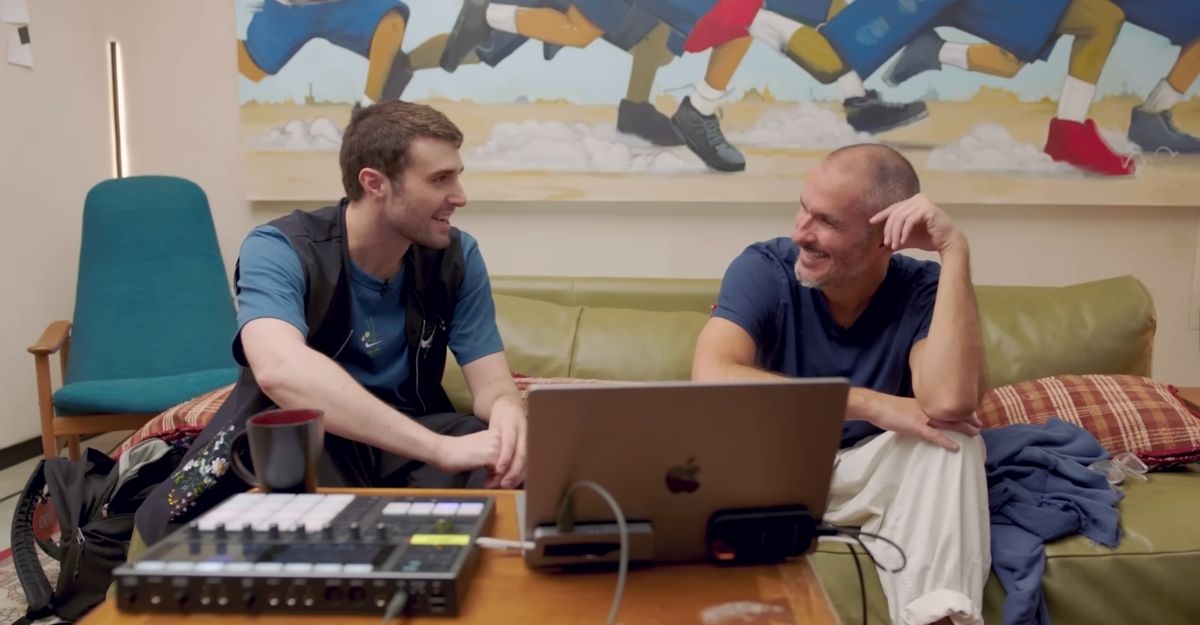
In the modern electronic music landscape, the line between DJing and live performance has become increasingly blurred. However, very few artists have managed to entirely shatter the barrier between the sterile studio environment and the raw, bleeding emotion of a live crowd. In 2022, British producer Fred again.. sat down with Apple Music’s Zane Lowe for a conversation that would quickly become legendary among producers, fans, and music historians alike.
This wasn’t just an interview; it was a masterclass in human vulnerability. Set inside the Los Angeles studio headquarters of Skrillex (Sonny Moore), Fred again.. bypassed the standard PR talking points. Instead, he picked up his Native Instruments Maschine controller and offered a profound, real-time look into his mind.
By dissecting the raw transcript of this conversation, we can extract the exact philosophies that have propelled Fred again.. to global superstardom. From his deeply rooted mentorship with ambient pioneer Brian Eno, to the beauty of catastrophic live-show failures, here is the ultimate breakdown of how Fred again.. engineers human emotion.
1. The Skrillex HQ and the “Actual Life” Philosophy
The setting of the interview itself is crucial to understanding Fred’s headspace. Lowe and Fred met in Skrillex’s Los Angeles studio, a space Lowe described as “the crown jewel of all he did”. Fred, who was doing a home swap with Skrillex at the time, admitted that Los Angeles isn’t a natural place for spontaneity compared to London. In LA, you don’t casually bump into “actual life” on the streets; it is a city of cars and isolated focus.
This contrast perfectly highlights the core thesis of Fred’s Actual Life project. The albums are designed as a deeply personal diary. His goal is to capture the mundane, fleeting moments of human existence and elevate them.
During the interview, Fred explained this using a brilliant analogy: “The feeling that I became really obsessed with was like trying to take the very fleeting moments and like trying to expose as much beauty as is in them… you know how sometimes if you see something in a normal thing and you see it in slow-mo it’s like oh wow there’s a whole new emotional framing for it”. Zane Lowe likened this to watching hummingbirds—creatures that move relentlessly fast in the darkness, only revealing their true magic when forced into slow motion. Fred’s music is the sonic equivalent of a hummingbird in slow motion.
2. The Maschine Controller: Sculpting Emotion Live
Halfway through the interview, Fred provides a technical demonstration that leaves Lowe speechless. The instrument at the center of his workflow is the Native Instruments Maschine—a modern sampler featuring 16 drum pads.
For Fred, the Maschine is not just a beat-making tool; it is an emotional translating device. He explained that he is desperate to make electronic music truly “live”. To demonstrate, he loaded a vocal sample of a poem: “I found you exploding brimstone on your lips… I found you beautiful”.
Rather than just laying the vocal over a static drum loop, Fred showed how he creates five or six different underlying ambient “drones”. By triggering different drones beneath the vocal in real time, the harmonic landscape completely alters the emotion of the words. A major chord makes the poem sound sweet and triumphant; a dissonant, minor drone turns the exact same vocal into a track possessing “terrible urgency”.
This is the secret to his live shows. When Fred is on stage, he isn’t just pressing play on a track; he is feeling the energy of the crowd and selecting the underlying harmonics on the fly to match the exact emotional frequency of the room.
3. The Brian Eno Mentorship: The Power of the “Childish” Mind
You cannot fully analyze Fred again.. without examining the towering influence of his mentor, Brian Eno. Fred began working with the legendary ambient producer when he was just 16 years old.
When asked about Eno’s genius, Fred didn’t point to Eno’s technical prowess; he pointed to his innocence. “I think in one word it’s because he’s a kid,” Fred explained. “He’s retained like just this childish like wide-eyed fascination with things… I was coming from the classical thing of like that’s how that [chord] looks on a score… in reality he’s listening to the way like that particular sound has overtones and it’s making the glass over there ring”.
Eno also provided Fred with the most crucial piece of advice for his solo career. When Fred was agonizing over thousands of unreleased, hyper-analyzed tracks, Eno told him: “You can’t learn anything from a piece of music that’s unreleased”. This broke Fred’s perfectionism, teaching him to rely entirely on instinct and to push his art out into the world.
4. The “Dragon” and the “Twin”: Collaborating with Burna Boy and Ed Sheeran
While Fred again.. is a solo powerhouse, his work as a producer for other massive artists deeply informs his process. Lowe asked him about the artists who have left an indelible impression on him.
Fred immediately highlighted Burna Boy, describing the Afrofusion superstar as “a dragon in human form”. Fred recalled Burna Boy walking into the studio in a silver, floor-length puffer jacket and simply exuding pure, unadulterated instinct. “He makes the line between like here and here as small as possible… the ideas just flow out for him,” Fred noted, admiring Burna Boy’s intense self-security.
Similarly, Fred discussed his profound collaborative history with Ed Sheeran. Describing their relationship as “very twin from the beginning,” Fred highlighted Sheeran’s relentless reliance on gut feelings. “It’s just Instinct Instinct Instinct Instinct every time he’s writing it’s just like go go work it out later,” Fred explained. By surrounding himself with artists who banish over-analysis, Fred sharpened his own ability to capture lightning in a bottle.
5. Embracing Chaos: Coachella and the “Rodney” Incident
Perhaps the most revealing segment of the interview is how Fred views live performance disasters. In a highly sanitized industry, Fred again.. actively relishes chaos.
He recounted his legendary 2022 Coachella performance. A minute before walking on stage, his in-ear monitors completely failed, leaving him with a wildly out-of-phase, quiet track in only one ear. The festival technicians told him they couldn’t fix it in time. Instead of panicking, Fred asked if it was solely a monitor issue. Once confirmed that the crowd could hear everything perfectly, he went out and played blind.
Amidst the chaos, the sun set perfectly over the festival. Fred, completely disconnected from his own audio, grabbed his microphone and shouted to his lighting director, Sam: “Sam you’re killing it right now man… I don’t know what this is but it’s fire!”. Sam replied that it was just the sun, to which Fred laughed, “Good job renting the sun for an hour”.
This embrace of the unscripted also applies to his viral Boiler Room set. When a wildly enthusiastic fan in a yellow shirt accidentally bumped the CDJ and stopped the music, the internet erupted. But Fred defended the fan—whom he affectionately referred to as “Rodney.”
“He’s so not the enemy,” Fred told Lowe. “He’s this joyful guy who’s everything you want your people to be in a club… if his arm or belly… happens to touch the pause button… who gives a f***… you can’t make projects called Actual Life and then get mad when actual life presents herself”.
6. The Depth of Grief and the Stephen Colbert Connection
The interview concludes on a profoundly heavy note. Zane Lowe gently points out that while Fred acts as a conduit for the voices he samples, the Actual Life project is fundamentally Fred’s own story of grief and recovery.
Fred admitted to struggling with “imposter syndrome” early on, feeling he hadn’t suffered enough to warrant writing about pain. However, after experiencing deep, personal loss, his perspective shifted entirely. To explain his current mindset, Fred played a two-minute audio clip for Lowe—a speech by late-night host Stephen Colbert.
In the speech, Colbert says: “It’s a gift to exist and with existence comes suffering… if you are grateful for your life… then you have to be grateful for all of it… What do you get from loss? You get awareness of other people’s lives… which allows you to love more deeply”.
Fred stated that this philosophy—the idea that suffering expands your capacity to connect with humanity—is his ultimate truth. It is the beating heart of his music. He takes the voices of friends, strangers, and grieving artists like Mustafa, and wraps them in euphoric club beats to remind us that while the suffering is real, we are all dancing through it together.
7. The Apple Partnership vs. The Steve Jobs Myth
Because this monumental interview took place on Apple Music, and because Fred so heavily utilizes the iPhone for his creative process, an amusing but false myth has spread online: that Fred again.. once played a live set for Apple founder Steve Jobs.
To definitively set the record straight: Fred again.. never played live for Steve Jobs. Jobs passed away in 2011, long before Fred became a mainstream touring artist.
However, his actual partnership with Apple is undeniable. Beyond the Zane Lowe interview, Apple Music selected Fred again.. to headline an exclusive Apple Music Live concert broadcast, capturing his USB002 performance in Dublin. Furthermore, his thunderous hit “Rumble” has been heavily featured in official Apple Event keynotes, proving that while he never played for Jobs, his music is firmly embedded in the company’s modern DNA.
Table 1: Fred again..’s Live Workflow & Studio Gear
| Gear / Element | Role in Fred’s Workflow | Context from Zane Lowe Interview |
| Native Instruments Maschine | The central hub for live drum sequencing and sample triggering. | Fred uses it to physically tap out rhythms, injecting a human “swing” into digital music. |
| Ambient Drones | Underlaying harmonic layers that dictate the emotion of a sample. | Changing a drone from a major to a minor key completely alters the context of spoken-word poetry. |
| iPhone Voice Memos | The primary source of audio for the Actual Life albums. | Fred records mundane moments (like a night out or a train ride) to capture unscripted humanity. |
| CDJs (Club Decks) | Standard club hardware used for DJ sets. | Famous for the Boiler Room incident where a fan (“Rodney”) accidentally bumped the pause button. |
Table 2: The Core Influences & Collaborators
| Figure | Relationship to Fred again.. | Impact & Philosophy |
| Brian Eno | Mentor (Since Fred was 16) | Taught Fred to maintain a “childlike” wonder and to release music based on instinct rather than over-analysis. |
| Burna Boy | Collaborator / Inspiration | Described by Fred as a “dragon,” possessing extreme self-security and unfiltered creative output. |
| Ed Sheeran | Long-time Collaborator | A “twin” in upbringing; heavily influenced Fred with his rapid, instinct-first songwriting process. |
| Mustafa | Sampled Artist (Actual Life) | His raw expressions of grief allowed Fred to explore deeper themes of loss and community healing. |
| Stephen Colbert | Philosophical Influence | Colbert’s speech on being “grateful for suffering” serves as the emotional baseline for Fred’s music. |
Table 3: Iconic Unscripted Live Moments
| Event | The Disaster | The Fred again.. Reaction |
| Coachella 2022 | In-ear monitors completely failed one minute before the set; audio was wildly out of phase. | Played blind, focused on the crowd, and jokingly thanked his lighting guy for “renting the sun”. |
| Boiler Room London | A fan named “Rodney” bumped the deck and stopped the music mid-drop. | Defended the fan, stating you cannot make music about “Actual Life” and get mad when actual life happens. |
FAQ
What gear did Fred again.. use in the Zane Lowe interview?
During the 2022 Apple Music interview, Fred again.. demonstrated his live workflow using a Native Instruments Maschine controller. He used its 16 drum pads to sequence beats and trigger ambient drones beneath vocal samples.
Did Fred again.. play a concert for Steve Jobs?
No. There is a persistent internet myth that Fred again.. played for Steve Jobs, but this is entirely false. Jobs passed away in 2011, years before Fred again.. became a mainstream solo act. However, Fred does have an extensive partnership with Apple, including his Apple Music Live Dublin concert.
What is the meaning behind the Actual Life albums?
Fred again.. describes the Actual Life albums as an audio diary. He samples iPhone recordings of nights out, transit rides, and conversations with friends to capture fleeting moments of everyday life and “expose as much beauty as is in them”.
What happened during Fred again..’s Boiler Room set?
During a highly viral moment in his Boiler Room set, an enthusiastic fan (affectionately nicknamed “Rodney” by Fred) accidentally bumped the DJ deck and paused the music. Fred famously embraced the mistake, later telling Zane Lowe that it was a perfect example of “actual life” presenting itself in the club.
Who is Brian Eno to Fred again..?
Brian Eno is a legendary ambient music producer who has mentored Fred again.. since Fred was 16 years old. Eno profoundly influenced Fred’s creative philosophy, teaching him to maintain a childlike fascination with sound and to trust his instincts rather than over-analyzing unreleased music.
What was the Stephen Colbert quote Fred again.. used?
During the interview, Fred played a clip of Stephen Colbert discussing grief. The core message of the quote is that existence is a gift, and because suffering is an inescapable part of existence, one must ultimately be grateful for suffering because it allows you to understand and love other people more deeply.

Sahil Chopra is a digital media specialist and the Managing Editor of Hercules & Love Affair. Backed by a formal diploma in Film & Television Direction from the Asian Academy of Film and Television (AAFT) and a degree in Business Management, Sahil combines his artistic vision with over four years of digital publishing expertise. He specializes in tracking the exact intersection where underground club culture meets high-end luxury lifestyle. Having closely followed the global electronic music scene from its early blog-era roots, Sahil now leads the editorial vision for the platform—curating everything from breaking entertainment news and VIP festival guides to exclusive looks inside celebrity culture. When he isn’t steering the newsroom, he is hunting down rare vinyl records and keeping a close eye on global fashion weeks.